
Steam – Digital business models post 2

Steam is an online digital content delivery platform on all major operating systems, allowing for games to be played online, from any device.
Steam took on a digital business model for Steam back in 2003, as a method of providing automatic updates for their released games on PC (Sayer & Wilde, 2018), initially starting out with Counter Strike (Counter Strike, 2000). When Valve initially founded the platform, they developed it with the idea of providing technical updates and content to their games through direct control. Ideally this was done to improve player experience, preventing the need for manual updating, improving the user experience of said games. In addition, it was a way for Valve to begin to foster a controlled social network around their games, allowing for server browsing for players. This was also supported in many ways, by the growth of online social media sites like Facebook, “Regular updates to the Steam software platform introduced social network features just as mainstream sites like MySpace and Facebook were emerging, and its popularity has undergone rapid subsequent growth.” (Moore, 2009). With these early stages of growth and implementation, Valve saw suit to further develop the platform for the upcoming 2004 release of, ‘Half-Life 2’. The previous success of the Half Life series had brought much of the fame and admiration Valve enjoys as a development studio in its early years, setting themselves up as a forerunner in the games development industry.
With Half-Life 2’s release in 2004, Valve had setup a new method of games distribution. By establishing Steam as a required piece of software in order to play Half-Life 2, they forced the player base to install the software. Valve’s goal was to make sure that gamers remembered, Steam was the place to go in order to play online with your friends. Not only did this force consumers into using their software, Valve did it in a way that made it seem like simply being another piece of software to have on their PC.
For Valve, the biggest sign of change came in 2005, with the release of the first non-Valve games onto Steam. With the release of Ragdoll Kung Fu (Healey, 2005) and Darwinia (Delay, 2005), this marked the beginning of the modern Steam storefront. Over the next 3 years we see the introduction of further developments for Steam, with dozens of additional games being added to the store. Players start to shift their view towards buying games online, directly from Steam, with the view for Steam to become the hub for all gaming on PC. Valves’ vision of turning Steam into the forefront of games distribution truly starting to come alive at this point. In 2007, we also see the platform integrate the use of new Steam Community features. Valve’s concepting of overall brand design for Steam has meant that their focus on community fostering lead to a huge expansion in their userbase, as gamers moved over to Steam as their main games distribution platform. On top of this, in a similar style to ITunes (McElhearn, 2016), it was a way for people to store all of their games in one place. With constant updates and new content being added regularly, players kept coming back to the platform.
At this point, another major method of relevance to the online gaming space was finally coming into play. DRM, or Digital rights management software, began to become a more prevalent technological requirement in the gaming space due to the rise in the rates of software piracy. With traditional games production, you would simply buy the game on CD, then placing it into your computer and play said game from the disk. However, Steam meant that when you purchased a game, you would be provided with a game key, acting as an authenticator to show the products legitimate status. At this point, Steam was built to be a DRM machine (Conditt, 2020). Over time, the majority of companies that sold games on disk required you to run it through Steam, with it acting as an authenticator, in an effort to reduce piracy. This not only won over the support of games developers when it came to choosing an online sales platform, but also meant that their online distribution model was now really starting to show serious returns. Their dominance in the field of online games distribution went unchallenged by any major competition, even now, their financial performance shows just how strong their market presence is. With the continual shift towards games as a service, rather than a product, and their financial success, Valve has made serious strides in shifting from a games development studio, to a digital service provider, due to the massive financial gains differences between the two.
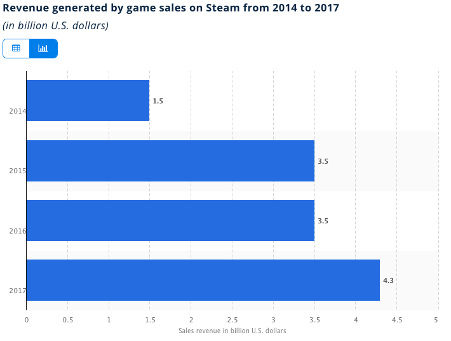
(“Steam sales revenue 2017 | Statista”, 2017)
(788 words)
References
Conditt, J. (2020). We’re all kinda fine with DRM now. Retrieved 6 March 2020, from https://www.engadget.com/2020/02/12/drm-geforce-now-steam-xbox-playstation-subscription-streaming/?guccounter=1&guce_referrer=aHR0cHM6Ly93d3cuZ29vZ2xlLmNvbS8&guce_referrer_sig=AQAAADfxtkgUoXcdUMXhk4UVJX3hcOO8Y4BqBrDO974llflxQF0-GDpkqp_6u-aDGmsB9DWGrVhj0jBh8tVJ0pmzyL0ZvHK4acn_qm6ke_x7Or5we7RM3AUyVemafX30z7VG6KSbVOZ3IY838ELjIJVywVYZhHUt_-bk_5yfsh-7oZck
Delay, C. (2005). Darwinia [Windows]. Walton-on-Thames, England: Introversion Software.
Healey, M. (2005). Ragdoll Kung Fu [Windows]. QI Studios.
McElhearn, K. (2016). 15 years of iTunes: A look at Apple’s media app and its influence on an industry. Retrieved 5 March 2020, from https://www.macworld.com/article/3019878/15-years-of-itunes-a-look-at-apples-media-app-and-its-influence-on-an-industry.html
Moore, C. (2009). Digital games distribution: The presence of the past and the future of obsolescence. Retrieved 5 March 2020, from https://ro.uow.edu.au/cgi/viewcontent.cgi?referer=https://scholar.google.com/&httpsredir=1&article=1943&context=artspapers
Sayer, M., & Wilde, T. (2018). The 15-year evolution of Steam. Retrieved 5 March 2020, from https://www.pcgamer.com/steam-versions/
Steam sales revenue 2017 | Statista. (2017). Retrieved 6 March 2020, from https://www.statista.com/statistics/547025/steam-game-sales-revenue/
Valve. (2000). Counter Strike (Version Release) [Microsoft Windows]. Washington, US.

 Gaming & Marketing